Patrick Winston's Algorithmic Guide to Human Attention

Our read
Brilliant ideas are entirely useless without the performative weaponry to sell them. MIT Professor Patrick Winston deconstructs public speaking into a series of cold, mechanical heuristics designed to hack human biology and attention, proving that articulate, average thinkers consistently outpace mute geniuses.


What happened
In this legendary MIT lecture, Artificial Intelligence pioneer Patrick Winston strips the magic from public speaking, reducing it to an algorithmic system of learnable heuristics. He argues that professional success is dictated by speaking, writing, and ideas, in that exact order. By mastering the mechanical rules of human attention, anyone can dominate more naturally talented rivals who rely on raw, unpolished intellect.
Key findings
Ending a presentation with a 'Thank You' or 'Questions?' slide is a self-sabotaging waste of prime real estate that signals you think the audience only stayed out of politeness, when you should instead keep your hard-earned 'Contributions' parked on the screen for the entire Q&A.
Human brains possess exactly one language processor, meaning every word plastered on a slide actively drowns out the speaker's voice and forces the audience to choose between reading or listening.
Quotes
“Your success in life will be determined largely by your ability to speak, your ability to write, and the quality of your ideas, in that order.”
Patrick Winston · 00:35
“It's extremely hard to see slides through closed eyelids.”
Patrick Winston · 11:42
“Your ideas are like your children: you don't want them to go into the world in rags.”
Patrick Winston · 51:24
“You get used to [being famous], but you know what? You never get used to being ignored.”
Julia Child · 51:17
The brief
Patrick Winston’s legendary lecture deconstructs the soft mythology of public speaking, revealing that elite gatekeeping is governed by status-seeking and attention mechanics.
By laying out the ruthless rules of job talks and the hidden advantages of stacking committees with old professors, he provides a highly practical survival guide for high-stakes corporate and academic environments.
Instead of letting speakers rely on slick deck templates, Winston exposes why low-tech blackboards and physical props hold the human brain hostage.
By mapping presentation mechanics to neurological tricks like empathetic mirroring, he proves that engagement is a game of physical pacing and visual targets.
The real battle on stage is not conveying information: it is managing the audience's low-level threat-detection and physical empathy.
Politeness is the death of impact. Winston dismantles the academic habit of self-effacing exits, proving that if you don't aggressively package your breakthroughs and plant your flag on the final slide, you are abandoning your ideas to be ignored.
It's a masterclass in treating communication as an exercise in raw cognitive real estate rather than a social compliance ritual.
Questions
Why is starting a speech with a joke considered a trap?
Starting a speech with a joke is a high-risk trap because audiences are still adjusting to your physical presence and vocal parameters. In the first few minutes, the audience's brain is calibrating to the speaker's voice, pitch, and physical presence, making jokes highly likely to fall flat. Speakers should replace entertainment with an immediate, transactional empowerment promise that outlines what the audience stands to gain.
How does text on slides affect audience comprehension?
Human brains possess exactly one language processor, meaning every word plastered on a slide actively drowns out the speaker's voice. Audiences cannot read text on a slide and listen to a presenter at the same time, forcing them to ignore one or the other. Plastering text on a slide turns your presentation into a silent reading session where your voice is treated as a distraction.
What is the optimal way to end a professional presentation?
Ending a presentation with a 'Thank You' or 'Questions?' slide is a self-sabotaging waste of prime real estate. The final slide remains on screen for up to 20 minutes during Q&A; filling it with a generic question mark or a URL that nobody writes down is a total waste of audience attention. Your final slide should be your 'Contributions' slide so your value proposition is burned into the audience's retinas while they ask questions.
Why does Patrick Winston advocate for using a chalkboard over PowerPoint?
The physical act of writing on a chalkboard forces a presentation to match the natural speed of human comprehension, triggering empathetic mirroring in the audience's brain that slide decks can never replicate. PowerPoint slides allow speakers to blast information at terminal velocity, whereas writing by hand forces a presentation speed that matches the audience's real-time cognitive absorption.
What is the 'Gray-Hair Arbitrage' in examination committees?
The hostility of an examination committee is inversely proportional to the age of its members. Young professors use oral boards to signal their own brilliance to their peers and will be vicious to prove their intelligence. Candidates minimize career risk by deliberately choosing old, established evaluators who already know their place in the world and have nothing left to prove.
Receipts
Visual-only receipts
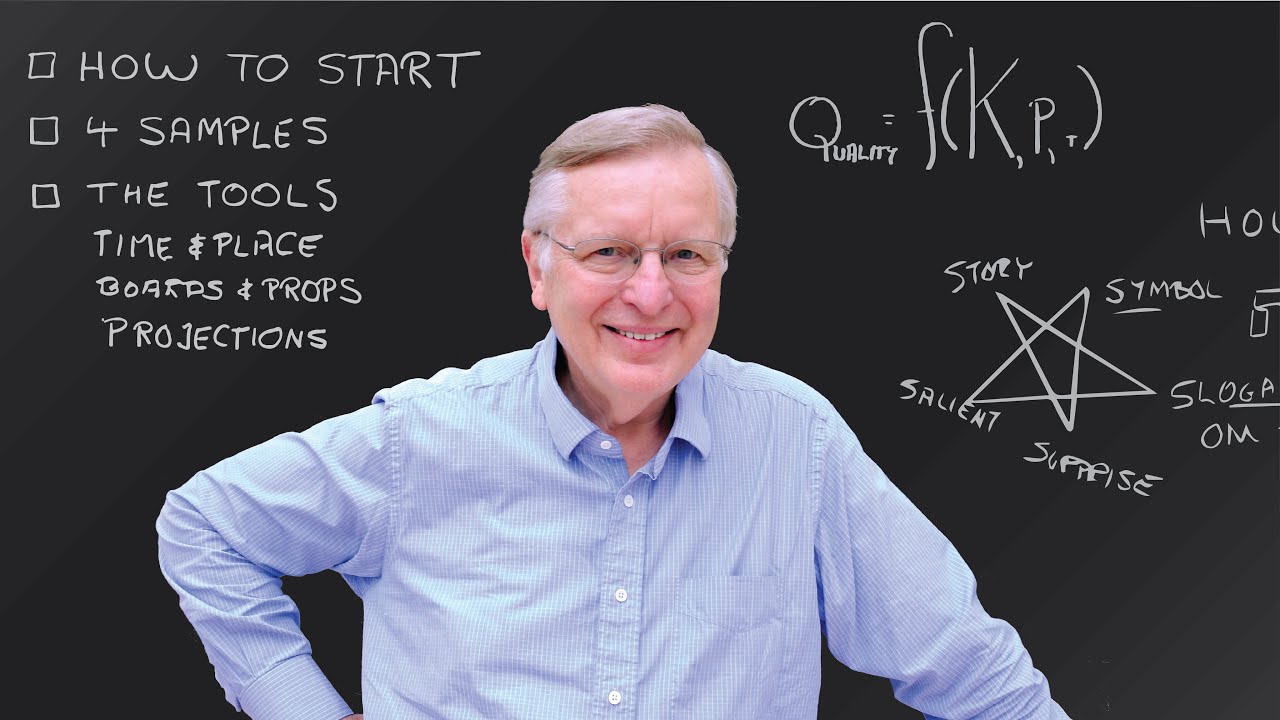
- Winston physically writes the communication quality equation Q = f(K, P, T) on a chalkboard next to a detailed hand-drawn diagram of a classic wood stove.
- To explain the concept of 'building a fence' around an idea, Winston physically manipulates three white wooden blocks on a table.
- Slide 'Collaborators' is crossed out with a big red 'X' to demonstrate that showing a massive list of co-authors at the end of a talk dilutes perceived individual contribution.