The 'AI won't take your job' cope is corporate liability insurance

Our read
The comforting corporate line that AI is just a friendly co-pilot is a deliberate PR buffer. Companies push the 'augmentation' narrative to keep human staff productive and cooperative while they quietly build the infrastructure to replace them.


What happened
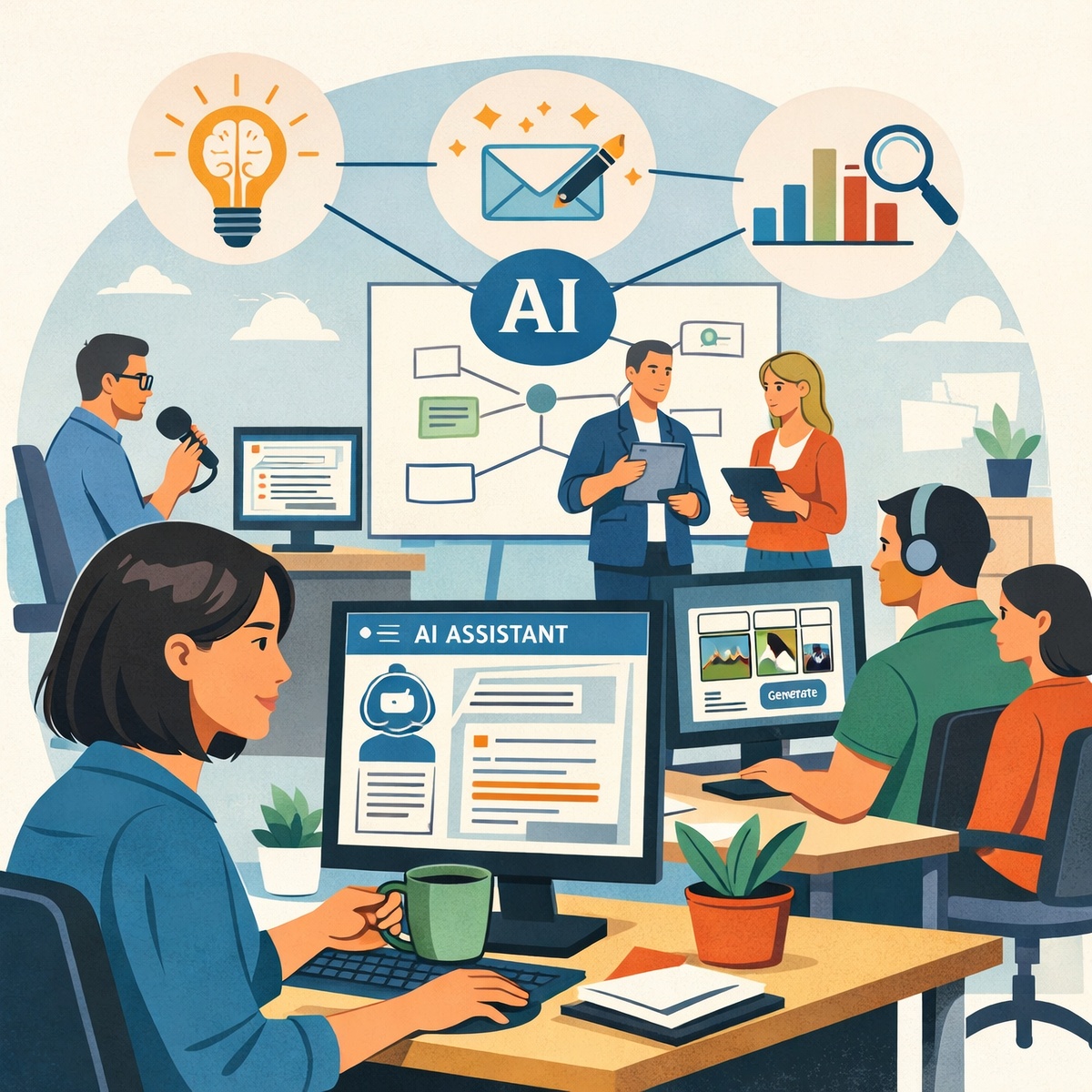
Industry analysts and corporate consultants at a Las Vegas panel insisted that artificial intelligence will only 'augment' human workers rather than replace them, downplaying immediate automation risks.
The brief
Telling employees they will merely be 'augmented' is the corporate equivalent of telling a turkey that the farmer is just helping it lose weight before Thanksgiving.
The sides
- Corporate Optimists
AI is merely a collaborative co-pilot that frees up human workers for higher-value creative tasks.
- Realist Operators
Consultants use the 'augmentation' narrative to prevent immediate labor panic while companies quietly build out autonomous pipelines.
Why now
As enterprises aggressively integrate LLMs into back-office workflows, the public-facing narrative has shifted from raw efficiency to therapeutic reassurance. Workers are actively tracking whether 'augmentation' is simply a polite euphemism for quiet downsizing.
Questions
Why do corporations insist that AI is only a co-pilot?
The co-pilot narrative is a corporate liability shield designed to prevent employee panic and maintain productivity during transition phases. If executives openly admitted that their goal is full automation, they would face immediate labor strikes, quiet quitting, and severe talent attrition. By framing AI as a friendly assistant, companies trick their current workforce into training the very models that will eventually replace them.
What is the actual economic incentive behind the augmentation narrative?
The primary incentive is maintaining operational stability while building automated infrastructure. Companies cannot afford a sudden drop in output while their AI systems are still in beta. Telling employees that AI will simply free them up for higher-value work keeps morale high and ensures that human workers willingly hand over their proprietary workflows and institutional knowledge to the software.
How do companies use human workers to train their own AI replacements?
Every time an employee corrects an AI draft, labels a dataset, or refines a customer service prompt, they are actively training their replacement. This feedback loop is disguised as a productivity upgrade. In reality, the human worker is acting as a temporary reinforcement learning agent, refining the model until its accuracy threshold matches or exceeds human performance.
What is the strongest counter-argument to the idea that AI will cause mass layoffs?
Optimists argue that technological revolutions historically create more jobs than they destroy, pointing to the transition from agriculture to industrial manufacturing. However, this perspective ignores the unprecedented speed of software replication. Unlike physical factories, an AI model can be deployed to millions of desks instantly, leaving displaced knowledge workers with zero time to retrain for entirely new industries.
What are the early warning signs that a company is planning to replace staff with AI?
The most reliable indicators are aggressive standardization of workflows, mandatory logging of daily tasks, and the introduction of custom internal LLMs. When management starts asking employees to document their step-by-step decision-making processes, they are creating the training data. A sudden hiring freeze in entry-level roles is the final signal that the automation pipeline is ready.
How will this corporate transition play out over the next three to five years?
We will see a quiet phase of attrition where departed employees are simply never replaced, followed by sudden, large-scale restructuring events. Middle management and repetitive administrative roles will be targeted first. Companies will transition to lean, highly leveraged teams where a single human operator manages a fleet of specialized AI agents, drastically lowering overall headcount.
Receipts
Related dispatches
- The Zone of Genius Cop-OutWhen the credentialed class realizes their hard skills are easily automated, they immediately retreat into HR-approved mysticism. Rebranding basic emotional intelligence as an elite 'Zone of Genius' is just a cope to avoid admitting that corporate paper-pushing is no longer economically viable.
- The Gallup AI Panic and the Luddite TrapThe drop in AI trust isn't a failure of the technology, but a predictable reaction to a media class that frames every efficiency gain as a corporate heist. Instead of preparing the workforce for high-agency leverage, institutional narrative-shapers are teaching Americans to fear the very tools that will keep the US competitive against state-subsidized foreign adversaries.
- LinkedIn's New 'Report AI' Button Is a Trap for Corporate Try-HardsLinkedIn is trying to play both sides of the AI boom by offering automated 'collaborative articles' to farm cheap SEO traffic while simultaneously deputizing users to snitch on the exact same low-effort slop. You cannot build an entire product suite around automated corporate-speak and then act shocked when the feed reads like a malfunctioning chatbot.
- The AI Midwit TrapThe corporate lie of AI as a harmless co-pilot is collapsing first for the people who actually use it. If your daily output can be replicated by a prompt engineered by a junior staffer, you are not being upskilled; you are being offboarded.
- The AI jobs apocalypse is postponed by basic mathThe tech elite's favorite sci-fi threat of immediate, total automation is hitting the brick wall of basic unit economics. It turns out that human beings, with all our flaws, are still the most cost-effective, self-replicating, energy-efficient computing units on the planet.
- The AI disclosure theater is a cope for insecure creativesThe obsession with slapping warning labels on AI-assisted art is not about protecting consumers; it is a defensive cope by a creative class terrified that their bespoke human output is indistinguishable from a prompt. If a piece of writing or art is so generic that a machine-generated label completely ruins its value, the problem is not the machine.