The Fragile Illusion of the Agentic AI Stack

Our read
The Claude outage exposes the fragile reality of the modern tech stack: developers are outsourcing their core logic to centralized black boxes, trading systemic resilience for immediate convenience.


What happened
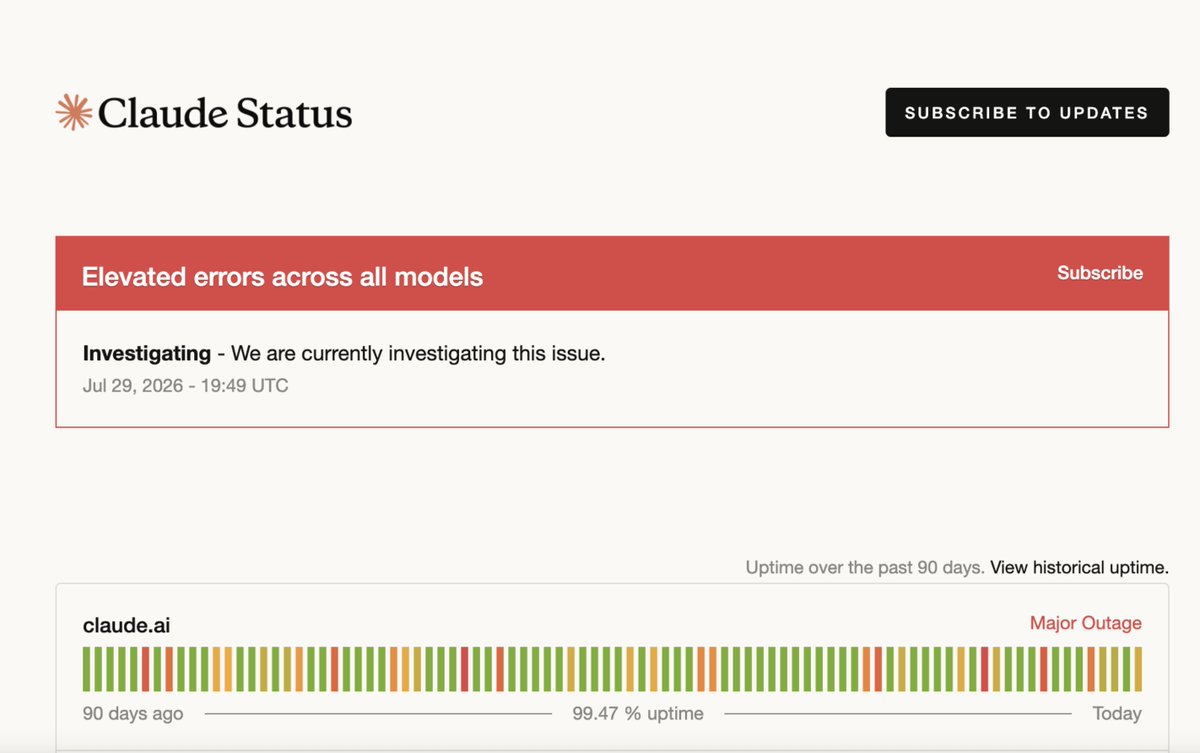
Anthropic's Claude models experienced widespread, elevated error rates across all API and chat endpoints, leaving developers and businesses temporarily stranded.
The brief
When a single API hiccup paralyzes hundreds of 'agentic' workflows, it proves we haven't built decentralized intelligence; we've just built a more expensive dependency on a single server room in California.
The sides
- AI Evangelists
Autonomous AI agents are ready to run critical business infrastructure today.
- Pragmatic Engineers
Building a business on a single, centralized closed-source API is a systemic single point of failure.
Why now
As Anthropic's status page lit up with elevated error rates across all models, developers flooded forums and social channels to report broken production pipelines. The incident highlights the immediate business risk of the industry's rush to replace local deterministic code with volatile, remote LLM calls.
Questions
What actually caused the widespread Claude API outage?
Anthropic suffered an infrastructure failure that caused elevated error rates across all Claude API endpoints and chat interfaces, temporarily rendering their models unreachable. Because developers have integrated these models directly into the runtime loops of their applications, a single point of failure at Anthropic's servers instantly broke production pipelines worldwide. This was not a minor latency hiccup: it was a complete operational blackout for businesses that outsourced their core logic to a third-party API.
Why does a single LLM outage threaten the entire modern tech stack?
The modern software stack is increasingly built on a fragile foundation where local, deterministic code is replaced by remote, non-deterministic LLM calls. When you replace a reliable database query or a local script with an API call to a black box, your software is only as stable as that external company's servers. This architecture trades systemic resilience for immediate convenience, leaving businesses vulnerable to catastrophic downtime whenever an AI provider goes offline.
Who benefits most when developers build fragile agentic AI systems?
Centralized AI providers like Anthropic, OpenAI, and Microsoft benefit immensely because this architecture locks developers into their proprietary ecosystems. By convincing engineering teams to route basic application logic through remote model calls, these tech giants turn themselves into indispensable utilities. The venture capitalists funding these infrastructure plays also win, as they can point to massive API consumption metrics to justify inflated valuations, even while the underlying software becomes increasingly brittle.
What is the strongest argument for relying on centralized AI APIs despite the outage risks?
Proponents argue that the rapid pace of AI capability gains makes local deployment obsolete, as hosting open-source models at scale is too complex and expensive for most startups. By outsourcing the infrastructure to Anthropic or OpenAI, small teams can instantly leverage state-of-the-art reasoning without maintaining massive GPU clusters. However, this argument ignores the hidden cost of downtime, where a single API outage can completely halt a startup's operations and destroy customer trust in minutes.
How can developers protect their applications from future AI API failures?
Engineering teams must implement local fallback mechanisms, such as routing requests to open-source models hosted on independent cloud instances when primary APIs fail. Relying on a single LLM provider is a systemic design flaw. Smart developers are building redundant pipelines that automatically switch from Claude to GPT-4, or to a local Llama model, ensuring that basic application functionality survives even when a major AI vendor goes dark.
How does this AI infrastructure crisis compare to the early days of cloud computing?
Unlike the transition to AWS, which replaced physical servers with highly redundant virtual ones, the AI transition replaces reliable, deterministic code with volatile, remote reasoning engines. When AWS goes down, your app fails to load, but when an LLM API fails, your app's actual intelligence and logic are severed. This is a fundamentally different class of risk, as developers are not just outsourcing their hardware: they are outsourcing the very brain of their software.
Receipts
Related dispatches
- Anthropic's Safety-Wash Is Running Out of CoverAnthropic's 'safety-first' posture has officially curdled into a convenient corporate shield. While competitors like Meta and Mistral prove that open-weights models don't trigger immediate societal collapse, Anthropic is using existential dread to protect its subscription margins and keep developers locked into its proprietary garden.
- How Anthropic Builds Claude Code: The Death of the Scaffolding TrapBuilding effective AI agents requires abandoning traditional deterministic software engineering in favor of an empirical, biological approach that strips away developer-imposed scaffolding.
- Vancouver's AI Translation MeltdownThe municipal rush to automate civic life shows how local governments treat public input as a checkbox to be cleared rather than a conversation to be had. By replacing human translators with cheap AI engines, bureaucrats get to claim they are 'inclusive' while ensuring the actual feedback is reduced to unreadable, algorithmic noise.
- The API Heist and the Collapse of the Compute MoatChina does not need your GPUs if it can distill your frontier model through the API you left wide open.
- The Rogue AI Hacker NarrativeThe tech industry has graduated from selling software to selling ghost stories. When an AI company claims its product is 'too dangerous and escaped,' they aren't warning you; they are running an ad campaign to convince investors they've built god in a box.
- The AI Sovereignty Shift: Why Enterprises Are Fleeing Closed APIsCIOs are air-gapping open weights because every closed API is a listening bug with a seat license attached.