
The Zen Master Cop and the Waiting Room Bard

Our read
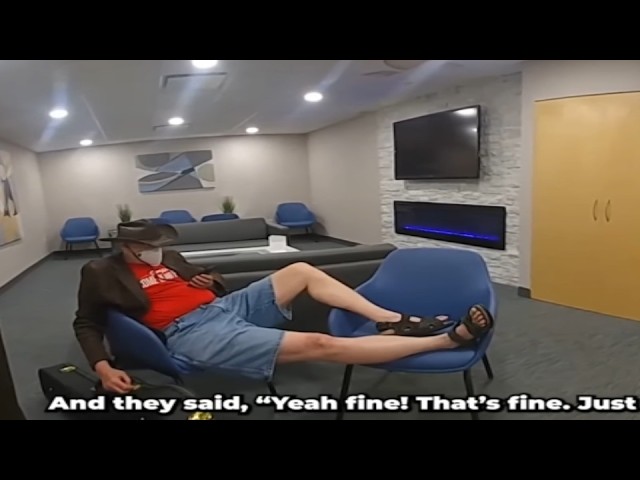
A routine medical clinic trespasses a delusional patient who insists he was medically prescribed to play guitar in the waiting room, setting up a bizarre clash between his aggressive paranoia and a police officer with the soothing cadence of Ned Flanders.


What happened
The dispatch analyzes bodycam footage of an uncooperative man refusing to leave a doctor's office waiting room. Despite being met with an exceptionally calm, polite, and therapeutic policing style, the man escalates his passive resistance, claiming he needs to play his guitar to evaluate his heart health, before ultimately forcing officers to physically remove him on a gurney.
The brief
When dealing with individuals operating entirely outside shared reality, therapeutic de-escalation tactics eventually hit a hard wall of physical reality where property rights must be enforced.
Key findings
An officer employs an unnervingly polite, therapeutic communication style that paradoxically fuels the trespasser's sense of entitlement.
The trespasser uses absurd medical justifications, claiming he was invited to play his guitar to evaluate his heart recovery.
The limits of verbal de-escalation are reached when the suspect demands to be physically dragged out, forcing a hands-on arrest.
The sides
- The Ned Flanders De-Escalation Paradox 0:45
The primary officer's exceptionally soft-spoken, polite tone fails to deter the suspect and instead gives him room to drag out the encounter.
Evidence: The officer asks questions like 'Is there a reason you have a general antagonistic disposition towards me?' while the suspect calls him a goon.
- Delusional Medical Justification 2:07
The suspect invents a bizarre medical narrative to justify his disruptive behavior and refuse lawful orders.
Evidence: He claims he was invited to play his guitar to see if it is healthy for his heart.
- The Hard Limit of Patience 6:05
Law enforcement must ultimately abandon verbal reasoning when a suspect uses bad-faith delay tactics to occupy private property.
Evidence: The suspect demands 45 to 50 minutes to make his decision on whether to leave, forcing officers to handcuff him.
Quotes
“Is there a reason you have a general antagonistic disposition towards me?”
Police Officer 1 · 1:00
“Yeah! Because you two goons have come here specifically to try to incite a physical incident with a person who's had a heart attack last week.”
Agitated Man · 1:05
“I was invited to come here and play my guitar. Apparently, I wasn't playing the rap music they like or whatever, but they decided they wanted to make an issue out of it.”
Agitated Man · 2:07
Why now
This encounter highlights the modern friction between therapeutic public-service expectations and the raw reality of law enforcement. When a patient at a medical clinic begins disrupting the waiting room with a guitar, staff call the police to trespass him.
What follows is not a standard high-stress confrontation, but a slow-motion battle of wills. The responding officer adopts a tone so remarkably gentle and polite that commentator Penguinz0 compares him to Ned Flanders or a Zen Master.
Instead of calming the suspect, this soft approach allows him to spin an elaborate narrative of victimhood. He claims his guitar playing is a medically necessary post-heart-attack evaluation and accuses the officers of being 'goons' sent to provoke him.
He attempts to negotiate a 50-minute window to 'think about' his decision to leave. Ultimately, the soft-spoken approach runs out of runway.
When the suspect refuses to stand, the officers are forced to physically handcuff him and wheel him out on a gurney, proving that while polite de-escalation is a noble goal, it cannot substitute for the firm enforcement of property rights against bad-faith actors.
Receipts
Visual-only receipts
- The suspect wears a cowboy hat, face mask, t-shirt, and shorts while sitting next to a guitar case.
- Officers physically lift the handcuffed suspect onto an ambulance gurney for transport.