
VFX Artists React to Bad & Great CGI 236

Our read
The golden eras of cinema achieved timeless, visceral reality not through infinite digital budgets, but through hyper-clever physical constraints, optical trickery, and selective anatomical distortion.


What happened
In this episode, the Corridor Crew breaks down the hidden mechanics of classic practical effects and modern digital creature design. They analyze how Terrence Malick's 'Days of Heaven' used reverse-motion peanut shells to simulate a locust swarm, how retro puppeteers separated optical elements to hide internal wiring, and why modern animators must physically mutate animal anatomy to make digital creatures emotionally relatable.
Key findings
Dumping thousands of peanut shells from a helicopter and running the footage in reverse creates a more visceral cinematic reality than any modern hundred-million-dollar CGI render pipeline.
To make digital animals emotionally relatable, Hollywood animators must physically mutate them by shifting their eyes to the front of their skulls, proving that biological accuracy is the natural enemy of cinematic empathy.
The ultimate trap of modern VFX is not the digital asset itself, but the contact zone where real human hands meet simulated fur, making simple physical hand acting the hardest thing to fake.
Quotes
“I lost a thousand calories in that one shot.”
Jordan · 00:50
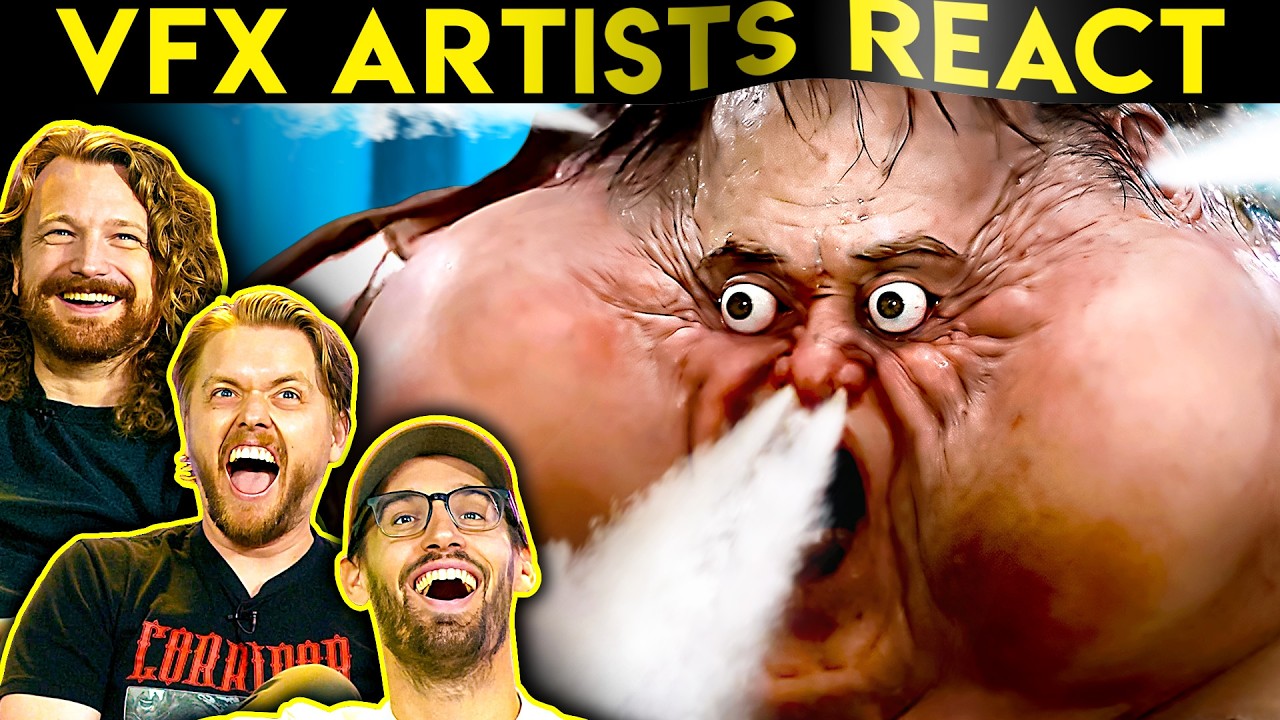
“They built a huge prosthetic dude with steam shooting out of his nose for like a second-long shot.”
Niko · 08:00
“What we're really missing there is first of all the timing of it... if you're waiting to pick up a little running lamb, you're going to be a more dynamic.”
Sam · 15:18
The brief
The magic of cult-classic VFX did not live in the abundance of computing power, but in the desperation of physical constraints.
Whether it is dumping helicopter loads of peanut shells to simulate locusts or shooting a puppet's hand as a separate optical element to hide wires, yesterday's cinematic giants succeeded because they could not simply click 'render.'
Modern digital pipelines can do anything, yet they often lose the visceral punch of a team of guys under a desk pulling bicycle brakes to inflate a latex monster.
We do not get fooled by high-polygon models; the true measure of visual effects is the physical contact zone where digital code meets biological reality.
By breaking down how modern creature features use anatomical distortions and practical puppetry on set, the Corridor Crew shows that cinema-grade magic still requires real-world physical references to keep from looking fake.
When actors interact with green screen space without physical resistance, the illusion collapses instantly.
Questions
How did Days of Heaven film the locust swarm without CGI?
The production team used reverse-motion filmmaking. Helicopters dropped thousands of peanut shells over the fields while actors walked backward. When the footage was played in reverse, the peanut shells appeared to be a swarm of locusts rising from the ground into the sky, perfectly mimicking natural insect flight patterns.
Why do animators change animal eye placement in movies?
Biological accuracy is the enemy of cinematic empathy. Real prey animals, like sheep, have eyes on the sides of their heads, which look like blank profile bumps from a front-facing camera angle. Animators physically shift the eyes forward on digital models to allow direct eye contact, enabling the audience to read human-like facial expressions.
What is static hand acting and why does it ruin VFX?
Static hand acting occurs when live-action actors freeze their fingers and hands in a rigid position while pretending to hold or lift a digital object. Because human hands naturally deform, micro-adjust, and shift weight when holding a real living creature, static hands instantly expose the CGI asset as a weightless digital sticker.
How did Big Trouble in Little China hide puppet wires?
The production used meticulous optical separation. To prevent internal light bulbs from washing out the details of the main Lo Pan puppet, the character's translucent hand was shot as a completely separate element on a black background and rotoscoped back into the frame, preventing light contamination from spoiling the illusion.
What is a kitbash refinery in digital environment design?
A kitbash refinery is a digital environment populated by repeating a handful of highly detailed 3D industrial assets. Instead of modeling a massive, unique facility, artists loop and duplicate a few pipe and tank models across the background, creating the illusion of a complex, sprawling industrial zone on a shoestring budget.
Receipts
Visual-only receipts
- Side-by-side production stills and behind-the-scenes footage (08:10 - 08:21) showing the physical construction of the multiple 'Thunder' inflating puppets, their internal cable rigs, and the air compressors used to blow up the latex skins.
- Side-by-side comparison of 'Aliens' and 'Halo', as well as 'Escape from New York' and 'Metal Gear Solid' (10:52 - 11:08), demonstrating the direct, unvarnished visual theft committed by early game developers.