
WeRecoverData's Final Retreat: The Paper Tiger of Corporate Lawfare

Our read
When independent sleuths expose corporate astroturfing and virtual-office theater, aggressive legal threats are often a desperate bluff that collapses into embarrassing public retractions under the light of public scrutiny.


What happened
Louis Rossmann details the final collapse of WeRecoverData's legal intimidation campaign. After threatening Rossmann with defamation over his exposure of their fake physical 'labs,' the data recovery firm quietly updated their Google Maps listings to 'Drop-Off Only' and blockaded the Wayback Machine to erase their historical claims. Their legal team ultimately issued a humiliating retraction, proving that corporate legal threats are often a paper-tiger bluff when met with actual documentation and unwavering personal resolve.
Key findings
When caught operating virtual offices disguised as physical data recovery labs, WeRecoverData's immediate defense was to block the Wayback Machine via robots.txt, vaporizing their own digital footprint while legally demanding their critic preserve his.
Quotes
“In retrospect, WeRecoverData recognizes this was the wrong first approach... it could and should have handled the matter differently, and is stepping away from that legal-first approach here.”
WeRecoverData's Counsel · 04:34
“WRD, through counsel, called it false and misleading to say WRD's advertised locations are virtual offices... and the listing WRD controls now tells the public the same thing our webpage says: that there is no lab at that address.”
Louis Rossmann · 20:17
“A case that takes those days away from me will have my complete attention for as long as it exists. At that time, WeRecoverData and your firm will witness what having 100% of my attention on its case looks like.”
Louis Rossmann · 30:03
The brief
When digital services firms get caught gaming Google Maps with fake virtual offices, their default play is to unleash corporate lawyers to bully independent critics into silence.
Louis Rossmann completely upends this dynamic by raising the personal and reputational costs of the fight, forcing the bully to defend their own systemic deception on the public stage.
By weaponizing defamation mitigation laws, a consumer rights advocate forced a bad-acting data recovery firm to publicly eat its own words, retreat from its physical-lab facades, and issue a humiliating retraction on its own blog.
It's a textbook victory for independent internet sleuths and a reminder that corporations will instantly fold their legal hands when their bluff is met with actual documentation.
Rather than defending their 22 national 'lab' locations, WeRecoverData quietly updated their Google Maps profiles to 'drop-off only' and uploaded corporate slides admitting there is no lab on-site.
The rapid retreat of WeRecoverData's legal team from issuing aggressive cease-and-desist orders to publishing humiliating public retractions on their own blog proves that corporate legal threats are often a paper-tiger bluff.
Questions
How did WeRecoverData try to hide their past advertising claims?
WeRecoverData retroactively updated their website's robots.txt files to block the Wayback Machine, erasing eight distinct historical snapshots of their location and pricing pages. This digital scrubbing was done to eliminate the public record of their false claims while their lawyers simultaneously demanded that Louis Rossmann preserve all of his evidence.
What did the investigation reveal about WeRecoverData's physical locations?
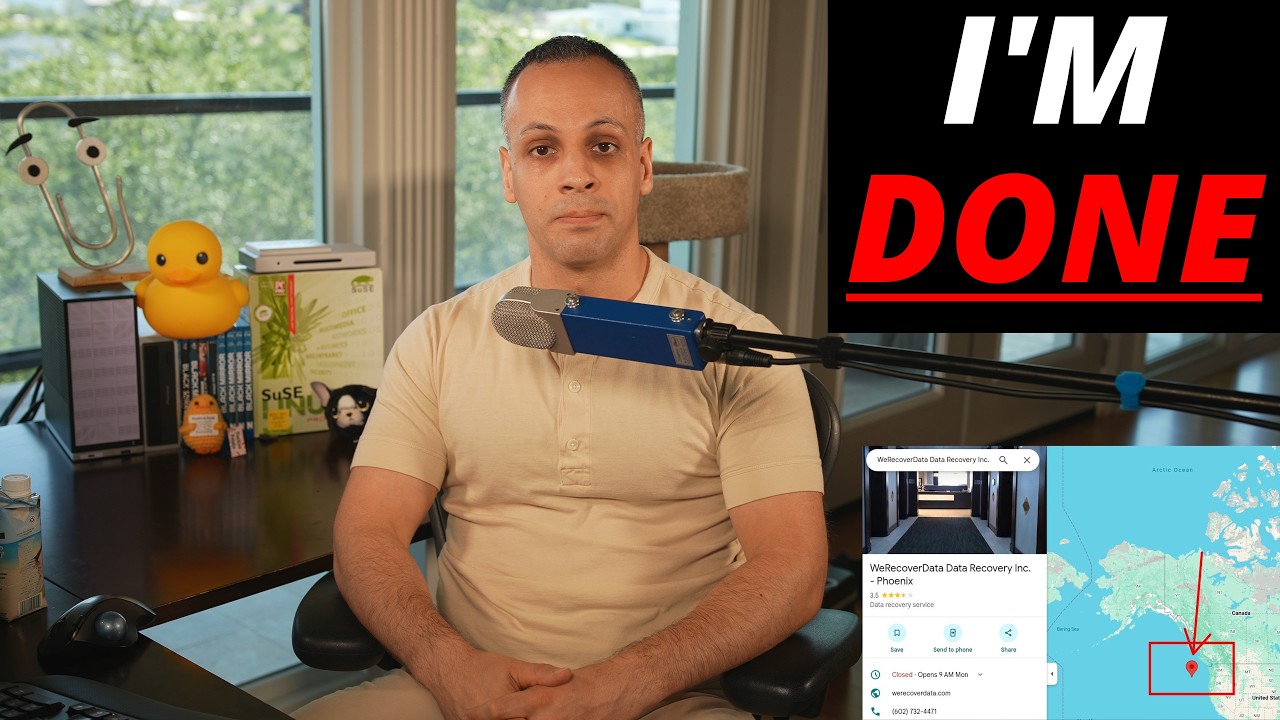
The investigation revealed that WeRecoverData's advertised physical labs were actually virtual offices and drop-off points. Out of 46 mapped locations, 30 resolved to Regus or WeWork virtual spaces, and 15 identical listings pointed to a single coordinates pin dropped in the Pacific Ocean off the coast of Washington state.
How did WeRecoverData respond to being exposed?
WeRecoverData quietly updated their Google Maps listings to display 'Drop-Off Only' and uploaded a corporate graphic explicitly stating 'Local intake - Drop-Off only. No Lab onsite.' This update confirmed the exact consumer warning they had previously threatened to sue Rossmann for publishing.
Why did WeRecoverData's legal campaign collapse?
Their legal campaign collapsed because Rossmann refused to be intimidated, documented every step of their deception, and raised the reputational stakes. Faced with public exposure and the threat of a scorched-earth legal defense, WeRecoverData's counsel admitted their legal-first approach was wrong and issued a public retraction.
What is the significance of the robots.txt block in legal disputes?
A retroactive robots.txt block allows companies to unilaterally wipe public archives of their past claims, creating an information asymmetry. It forces critics to rely on the company's unverified internal archives rather than a neutral, third-party public record, making it a powerful tool for corporate gaslighting.
Receipts
Related dispatches
- The Corporate Bluff Collapses: WeRecoverData's Final RetractionPredatory service operations rely on cheap legal threats to bury consumer advocacy, but calling their bluff with public exposure turns their empty cease-and-desist letters into humiliating, self-inflicted retractions.
- Rossmann Exposes AI Astroturfing in Texas Parkland DisputeIndustrial developers in Taylor, Texas, are caught using generative AI botnets to manufacture grassroots consent for a contested data center, exposing corporate panic through pathologically polite syntax.
- Panera Bread and the Death of the Consumer ContractUnilateral modification clauses and forced arbitration have transformed consumer contracts into legal memes, allowing corporations to pocket prepaid annual fees and immediately strip away promised services with zero legal recourse.
- Hugging Face Uses Chinese AI Over Guardrailed US ModelsSilicon Valley safety culture is a national security threat. While US tech companies spend billions lobotomizing their models so they don't say anything offensive, China is building raw, uninhibited software that actually gets the job done. We are literally losing the cyberwar because our code has HR-approved anxiety.
- Why Nothing Changed After the Culture WarBuilding parallel media playpens is a losing strategy. The real battle is a grinding, bureaucratic fight to re-occupy legacy institutions that hold civilizational authority.
- The Open Source AI Gatekeepers Are Running Out of ExcusesThe sudden corporate pivot to AI safety-washing is not about preventing a sci-fi apocalypse; it is a classic regulatory capture play designed to criminalize the competition and turn open-source development into a liability.
Visual-only receipts
- Screenshots of WeRecoverData's Google Maps listings showing their locations relocated off the coast of Washington in the Pacific Ocean (00:44).
- A Google Maps business listing showing 'WeRecoverData Data Recovery Inc. - Drop-Off' with a newly uploaded slide card stating 'Local intake - Drop-Off only. No Lab onsite.' (11:03).