
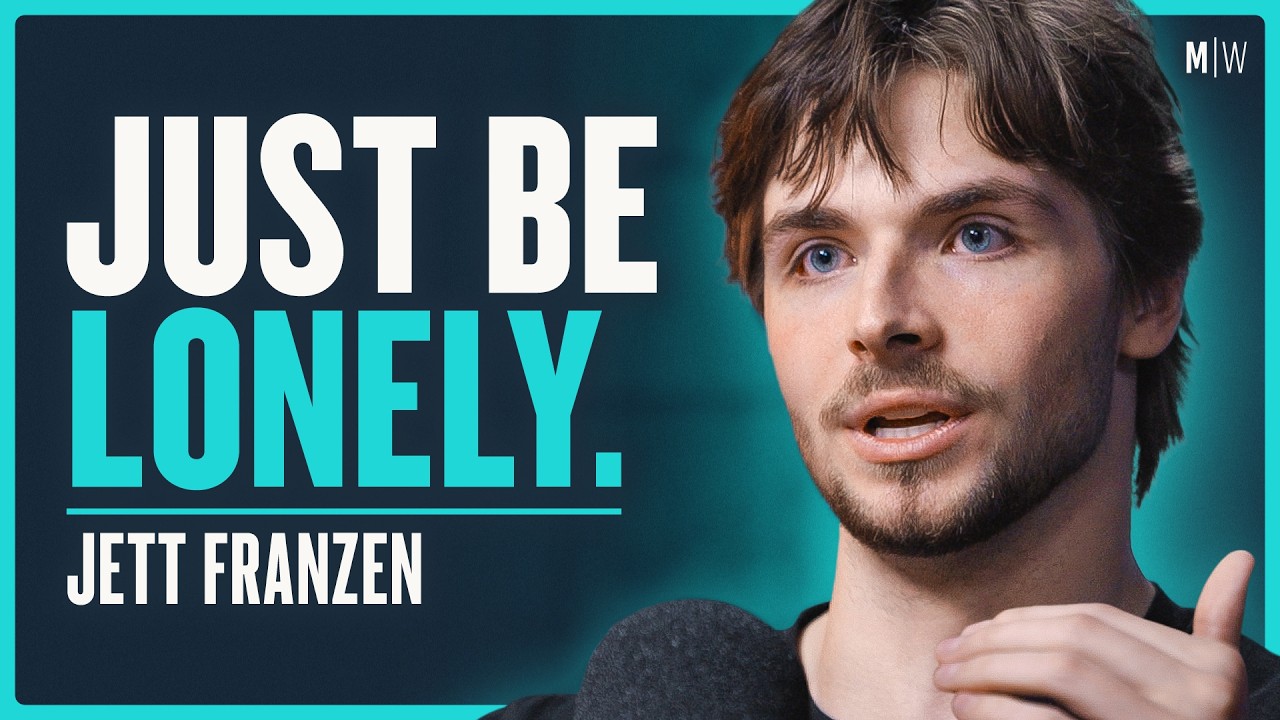
Why Almost Nobody Gets The Life They Want - Jett Franzen

Our read
Modern self-improvement and therapeutic culture offer comfortable escapes from personal responsibility, but true self-belief is built solely on an undeniable stack of real-world evidence.


What happened
Chris Williamson and Jett Franzen dismantle the modern self-help industry's obsession with positive affirmations, manifestation, and victimhood. They argue that high-status habits are often sophisticated coping mechanisms used to run from personal trauma, and that real confidence must be earned through high-repetition, unglamorous grind. By examining the biological realities of human desire and the psychological traps of 'suicidal empathy,' they expose how both the losers who pathologize success and the winners who achieve it are trapped by the same evolutionary design: the human brain is built for the chase, not the capture.
Key findings
Extreme professional output is frequently just a high-status coping mechanism designed to run away from a childhood shadow of feeling ugly, poor, powerless, or unloved.
Positive affirmations are a biological dead end because the brain is hyper-aware of its own flaws: true self-belief requires a 'make it until you believe it' approach built on an undeniable stack of proof.
Modern 'suicidal empathy' functions as a cultural speed governor by validating a person's self-destructive habits under the guise of compassion, trapping them in long-term failure.
Quotes
“Confronting yourself is almost like psychological suicide in a way... because you're basically trying to expose yourself to yourself.”
Guest · 02:15
“There is 'fake it until you make it', but there is an alternative, which is 'make it until you believe it'... developing the stack of proof so high that your self-doubt is crushed under the weight of evidence.”
Chris Williamson · 10:27
“The next stage of your development might not be more effort, but more ease: it might not need more grind, but more grace.”
Chris Williamson · 22:55
“In your mind, redefine the word blame as 'give power to.' And when you do that, there's only one person you're going to want to give more power to, and that's you.”
Alex Hormozi (quoted by Chris) · 40:14
The brief
The modern self-help space is obsessed with the illusion of effortless success, peddling flow state and vibe-maxing as shortcuts to mastery. This episode exposes the lie by showing that true spontaneity is a luxury purchased only with the currency of highly disciplined, repetitive grind.
You must build the cage of rules before you can enjoy the freedom of breaking them.
When society trades merit for victimhood, weakness becomes the ultimate social currency. By coddling self-destructive habits under the banner of empathy, the modern therapeutic state acts as a speed governor on human potential, trapping people in their own self-inflicted scars.
True agency means launching a rebellion of one, choosing personal accountability over the cheap comfort of systemic blame.
Modern self-improvement culture promises that hitting your destination will finally cure your internal rot, but evolutionary biology disagrees.
By exploring the "inner citadel" and the arrival fallacy, this clip exposes how both the losers who pathologize success and the winners who achieve it are trapped by the same biological reality: the human brain is built for the chase, not the capture.
True peace requires embracing Sisyphus's boulder instead of expecting a golden trophy to act as a surrogate soul.
Questions
Why is 'fake it until you make it' a dangerous strategy for creators?
Faking competence before you have built the latent leverage of high repetitions ruins long-term potential. Early luck exposes a lack of readiness and denies you the actual competence required to survive the spotlight when it finally hits. True self-belief is built by making it until you believe it, accumulating a stack of real-world proof so heavy that self-doubt is crushed under its weight.
How does 'suicidal empathy' hold individuals back from achieving success?
Suicidal empathy is a cultural pathology that validates self-destructive habits under the guise of compassion. By shielding struggling individuals from constructive friction and critical feedback, it traps them in long-term failure while keeping the coddling class feeling morally superior. This turns the achievement-based value system upside down, celebrating weakness and dependency while vilifying success.
What is the 'Inner Citadel' and how does it protect the ego?
The Inner Citadel is a psychological retreat where individuals who fail to meet societal standards of success protect their egos by rewriting moral rules to make those standards look evil or pointless. Online subcultures, such as anti-work advocates or 'healthy at any size' activists, often use this defense mechanism to rebrand their personal limitations as enlightened philosophy, avoiding the pain of personal responsibility.
Why do high achievers experience a psychological crash after winning?
This crash is driven by the Arrival Fallacy and Lacan's theory of desire, which states that an object of desire must remain perpetually absent to be wanted. The second a massive external milestone is secured, the brain biologically kills the desire, revealing that external accolades are entirely incapable of healing internal anxieties. Human satisfaction is evolutionarily wired to exist only in the pursuit of a goal rather than its ultimate capture.
How does talking about your goals affect your ability to achieve them?
Talking about a goal triggers the same neurological reward centers as actually achieving it, creating a dangerous biological loophole. This verbal aspiration satisfies the brain's reward mechanism, neutralizing the actual incentive to execute. It explains the epidemic of 'ambitious lazy people' who love the aesthetic of entrepreneurship but vanish when it is time to do the actual work.
Receipts
Lexicon from this episode
- Suicidal EmpathyWestern institutions have developed a civilizational autoimmune disease where the elite systematically sacrifice the physical safety of their own citizens to avoid looking impolite.
- The Art of the ChokeThe modern self-help industry sells positive affirmations to hide the brutal reality that your brain is a ruthless BS detector. The Art Of The Choke is the trap of substituting mirror-work and manifestation for actual competence, hoping nice feelings will rescue you when the pressure finally mounts.
Visual-only receipts
- At 57:09, a video clip of golfer Scottie Scheffler's press conference is shown on screen, displaying the text overlay: 'SCOTTIE SCHEFFLER SAYS BEING A GOLFER IS NOT A 'FULFILLING LIFE'