
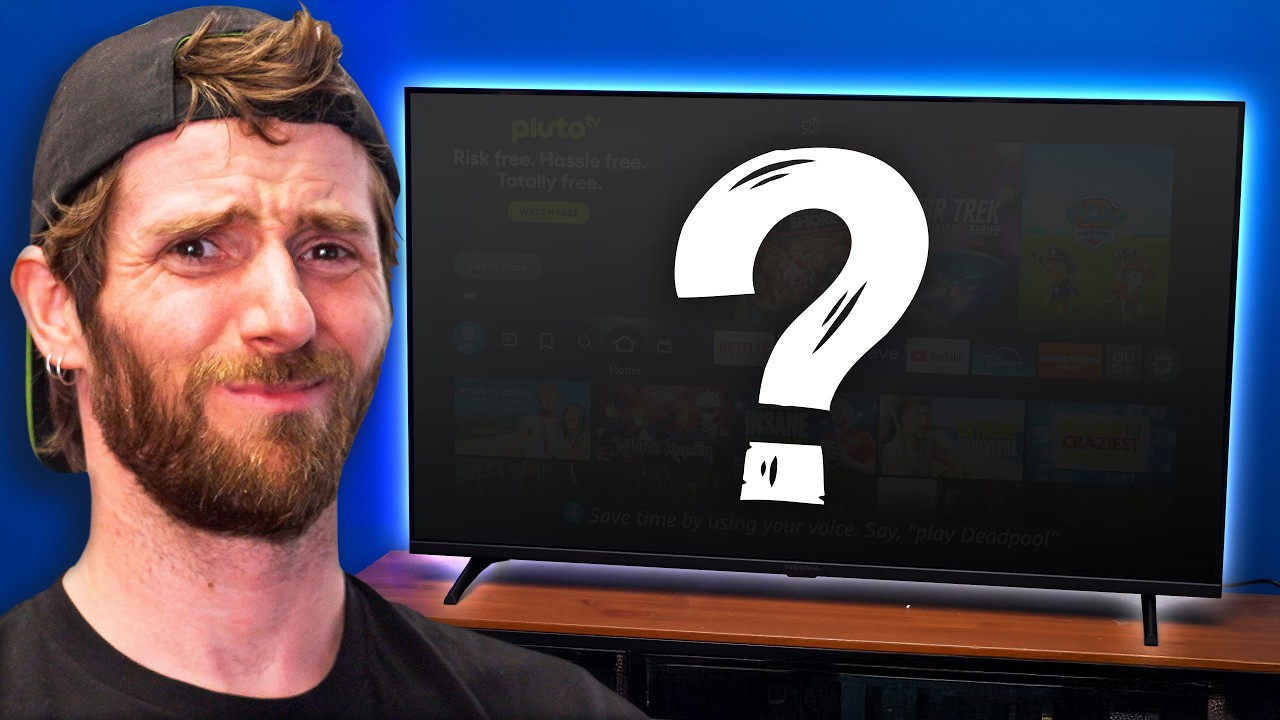
Why Everyone is Buying This $200 TV

Our read
High-end TV brands are stripping physical ports to force consumers into premium wireless ecosystems, leaving a bargain-bin $180 Insignia to quietly dominate as the last display with legacy inputs and shockingly accurate out-of-the-box colors.


What happened
Linus Tech Tips cuts through corporate spec-sheet bloat to show why Amazon's absolute cheapest $180 TV is quietly dominating the market. By keeping legacy ports that premium brands deleted to look "minimalist" and delivering surprisingly accurate factory color calibration, this bargain-bin panel proves that luxury TVs are overcharging for features you do not need.
Key findings
High-end TV manufacturers are stripping legacy ports to look sleek, leaving the bargain-bin $180 Insignia to quietly dominate as the only display left that supports composite inputs, ethernet, and headphone jacks without a pile of dongles.
While the Insignia boasts HDR10 compatibility on the box, it is a hardware lie, peaking at a dim 257 nits on a direct-lit panel that turns into a grey mirror on sunny afternoons.
Despite a sluggish Fire TV interface that takes multiple clicks just to render a menu, the panel features a hidden game mode with a lightning-fast 10ms response time that rivals gaming monitors three times its price.
Quotes
“For some reason, the TV industry seems to have fallen victim to the same affliction that the smartphone industry did: where the top-end models tend to be missing I/O that the bottom-end ones have.”
Linus Sebastian · 03:19
“This TV, while it may 'support' HDR10 in that it can understand the content format, is not capable of high dynamic range.”
Linus Sebastian · 08:24
“Low input latency does not a gaming display make.”
Linus Sebastian · 12:19
“There's no bad products, just bad prices.”
Linus Sebastian · 13:29
The brief
Display technology is one of the rare consumer hardware sectors resisting hyper-inflation, allowing a bottom-shelf $180 TV today to easily outclass the premium display panels that cost thousands a decade ago.
While global economic pressures have driven up the cost of almost all physical goods, display panels have steadily dropped in price while increasing in baseline performance. Rapid manufacturing scaling acts as a direct wealth transfer of high-end capabilities to budget-conscious buyers.
However, low input latency is a marketing trap if the screen's grey-to-grey pixel response times are so slow that turning your camera in a first-person shooter instantly liquefies a 4K image into a smeared watercolor painting.
1ms GtG response time, turning fine details like grass in Doom Eternal into a green blur. Brands exploit single-number spec sheets like input lag to mask structural panel deficiencies like slow VA liquid crystal transition times.
Ultimately, the ultimate defense of cheap hardware is the "no bad products, only bad prices" rule. Severe engineering flaws are entirely forgivable if the retail price drops faster than the performance metrics.
A 55-inch 4K TV costs only $180, meaning flaws that would instantly disqualify a premium gaming monitor are easily overlooked. Consumer expectations must scale with financial risk, and sub-$200 display hardware is ultimately utility gear, not enthusiast luxury.
Questions
Why are high-end TVs losing physical ports that cheap TVs keep?
Premium TV manufacturers use "sleek minimalism" as a cover to strip physical utility and force users into proprietary wireless audio ecosystems. Budget TVs like the $180 Insignia keep legacy composite inputs, hardwired ethernet, and headphone jacks because their buyers refuse to pay for expensive wireless dongles and adapters.
How can a TV support HDR10 but not display high dynamic range?
This is a marketing loophole known as spec-sheet compatibility. The TV's software is compatible with the HDR10 metadata format and can decode the signal, but the physical hardware lacks the backlighting power to render it, topping out at a dim 257 nits instead of the 1000+ nits required for true HDR.
Is the $180 Insignia TV good for gaming?
It is a mixed bag. While input latency drops to a spectacular 10.1ms in Game Mode, the physical VA panel has slow grey-to-grey pixel response times. This means fast-paced motion will suffer from extreme ghosting, turning high-action scenes into a blurry smear.
How accurate are the colors on Amazon's cheapest 4K TV?
Surprisingly excellent. Out of the box in "Natural" mode with a "Warm" color temperature, the TV achieves a near-perfect delta-E color accuracy score of 1.87. This rivals calibrated professional displays and beats many premium TVs that rely on aggressive AI upscaling.
Why is display technology getting cheaper while everything else inflates?
Massive manufacturing efficiency gains and aggressive scaling in panel production have outpaced standard consumer inflation. Displays are one of the few tech categories where baseline performance has steadily increased while the entry-level retail price has plummeted.
Receipts
Visual-only receipts
- LTT Labs graphs at 08:36: Peak Luminance vs Window Size showing standard HDR flatlining at 256.62 cd/m².
- LTT Labs graphs at 08:47: Grayscale - HDR tracking PQ EOTF and Contrast Ratio of 6741:1.
- LTT Labs color check delta-E graphs at 09:36 and 09:46 showing exact delta-E 2000 metrics for Movie vs Natural mode.
- Screen showing Cyberpunk 2077 input lag tests at 11:31 showing 63.8ms in Standard, 43.2ms in PC, and 10.1ms in Game Mode.