
Moral Upholder (Poet/Bard)

The take
The Moral Upholder was a historical job: public morality plus shared narrative in one role. Mass media fractured that seat, and cultural memory paid the bill.
The Tell
Ancient bards built society's moral OS. Today, algorithms just build your feed. What's upholding your values?

Stakes
Ancient storytellers are the origin story. The live fight is the fracture: from a unified cultural narrative to a scrum of contradictory sources vying to shape public morality, and who actually gets to define shared values now.
The read
Before mass media, the 'Moral Upholder' was often the poet or bard, a central figure like Homer or the authors of the Mahabharata, whose epic narratives weren't just entertainment.
These stories were the operating system for society, embedding moral lessons, cultural values, and shared memory directly into the community's consciousness. The mainstream often dismisses poets as niche artists, their moral influence confined to literary circles or academic study.
But this view entirely misses the historical function of the bard, who, through compelling storytelling, actually forged and maintained community values, providing a cohesive moral framework that transcended individual interpretation.
Today, that singular role is fractured across countless, often conflicting, information streams.
Mass literacy and the rise of digital media have diluted the bard's unifying power, replacing it with a cacophony of influencers, algorithms, and fragmented narratives all vying to transmit 'moral signals.'
The real fight isn't about poetry; it's about who gets to define and transmit shared cultural values in a world drowning in data.
In the wild
- "The poet is sort of seen as this upholder of the moral order."
- Homer's Iliad and Odyssey were foundational moral texts for ancient Greece.
- The Vedic epic tradition, like the Mahabharata, served as a moral compass for generations.
- The printing press and mass literacy decentralized narrative authority, starting the shift.
- Episode: Odyssey's Enduring Echo: Patriarchy, Propaganda, and Persuasion (https://www.youtube.com/watch?v=cVsepqYjXQM)
- The poet is sort of seen as this upholder of the moral order.
Related
 Community Notes (Platform Governance)Community Notes looks like crowdsourced fact-checking. In practice it is how platforms let the majority selectively police narratives that challenge institutions, often burying inconvenient truths under 'context.'
 Meme a Dream into RealityWhen a founder 'memes a dream into reality,' they're not just telling a story; they're publicly performing radical conviction to build a vision from scratch, because the cost of *not* forcing a choice between joining or dismissing their future is being ignored entirely.
 Podium MulticulturalismA country will drape itself in a Black striker the night he wins the final and question his passport by breakfast. Podium multiculturalism hands minorities the label 'us' only while they're holding the trophy, and 'them' the second the whistle blows.
 Euphoric PlagueThe real risk of a 'euphoric plague' isn't a bioweapon that makes you happy to spread disease, but the digital dopamine loops that turn us into unwitting super-spreaders of narratives, regardless of the cost.
 Age of the CharacterPlatforms now pay for persona wattage over argument. Age of the Character is the tell: entertainment value ate the discourse, and the bit outperformed the brief.
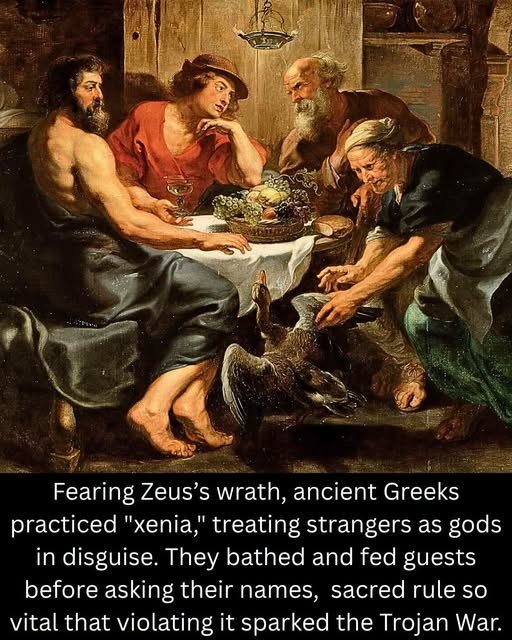 Zeus' Law of HospitalityZeus' Law of Hospitality wasn't just about being nice to strangers; it's a brutal economic and social contract that kept ancient societies from collapsing into total anarchy. Violating it was a direct challenge to the fragile order, with real-world costs disguised as divine wrath.
Gifnotes poster
Sources
FAQ
What did ancient "moral upholders" actually do?
They were the primary architects of cultural memory and societal values, using epic stories to transmit ethics, history, and identity across generations, essentially serving as society's moral operating system.
How did mass media change this role?
Mass media, especially with increased literacy, splintered the centralized authority of the bard. It decentralized narrative creation and distribution, leading to a multitude of voices and often conflicting moral signals, rather than a single, unifying narrative.
Who holds this role today, if anyone?
No single entity holds the full "Moral Upholder" role today. It's diffused across influencers, algorithms, media outlets, and even individual content creators, each contributing to a fragmented and often contradictory landscape of public morality.