DeepSeek V4: Underdog AI's Million-Token Efficiency Breakthrough (XJUpuOBpT-4)
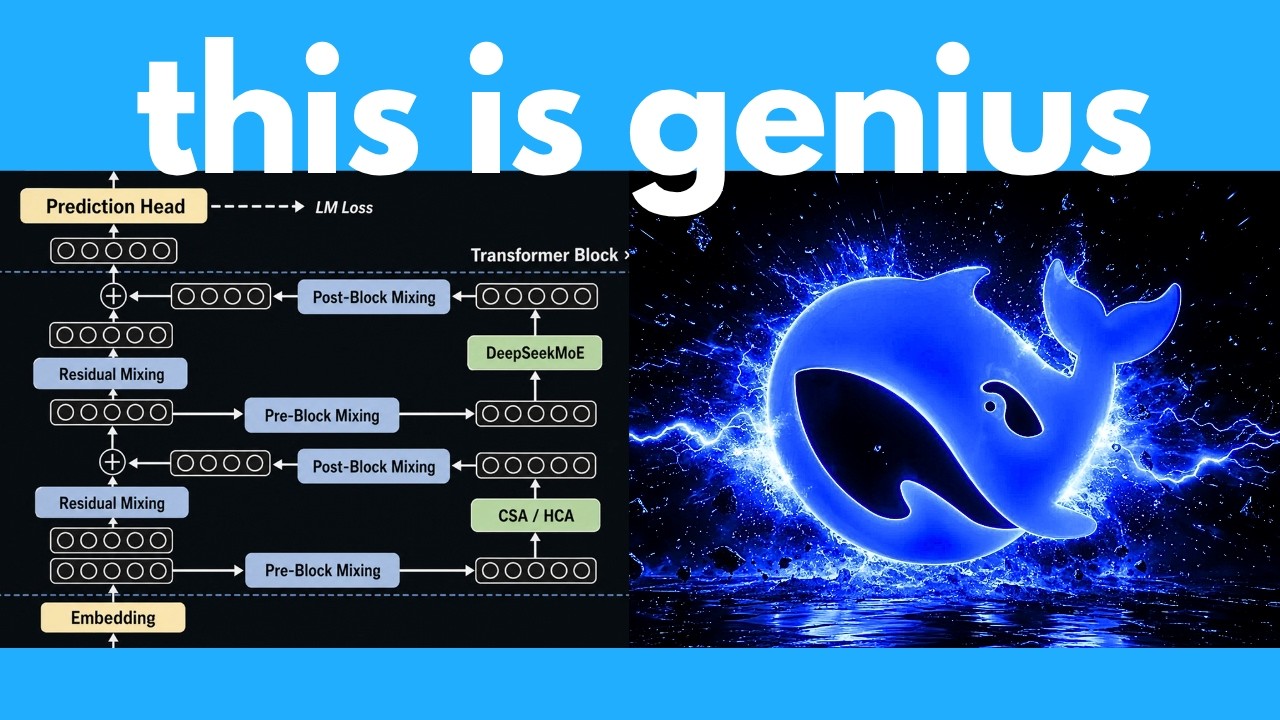
DeepSeek V4-Pro, from a resource-constrained team, is out-innovating AI giants by pioneering a 'Hybrid Attention Architecture.' This design intelligently mimics human cognition to conquer the 'Attention Bottleneck,' enabling 1 million token context windows with drastically reduced compute and memory. It's a blueprint for democratizing powerful AI through elegant engineering, not just brute force.
Key findings
DeepSeek V4-Pro, from a team 40 times smaller than OpenAI and lacking top-tier NVIDIA chips, achieves performance comparable to leading closed AI models by focusing on architectural efficiency.
The new 'Hybrid Attention' architecture allows DeepSeek V4-Pro to process a 1 million token context window using only 27% of the compute and 10% of the KV cache memory required by its already efficient predecessor, DeepSeek V3.2.
DeepSeek effectively sidesteps the computational explosion of traditional large language models by employing a multi-layered attention strategy (Compressed Sparse Attention, Heavily Compressed Attention, and Sliding Window Attention) that selectively processes information, mimicking human reading comprehension for ultra-high context efficiency.
Why it matters
This dispatch unpacks how DeepSeek V4-Pro achieves performance comparable to leading closed AI models despite a 40x smaller team and limited hardware. Its core innovation, the 'Hybrid Attention Architecture,' combines Compressed Sparse Attention (CSA), Heavily Compressed Attention (HCA), and Sliding Window Attention (SWA) to efficiently manage context over extremely long sequences. This multi-layered approach slashes compute requirements by 73% and KV cache memory by 90%, proving that strategic architectural design can democratize access to powerful LLMs by making them astronomically more efficient and challenging the prevailing 'bigger is better' paradigm.
Argument map
- DeepSeek's resource limitations make its achievements exceptional. 0:05
DeepSeek, despite being significantly resource-limited compared to top closed AI labs, has built a world-class model that they open-sourced.
Evidence: DeepSeek's team size is ~150-200 employees vs. OpenAI's ~4,500 (40x smaller). (0:22) They lack 'unlimited compute' and 'top Nvidia chips.' (0:12, 0:19) DeepSeek V4-Pro-Max matches or beats top closed models on benchmarks. (0:29) They open-sourced the model and released a paper. (0:33, 0:35)
- Traditional LLM architectures face an 'attention bottleneck' for long context windows. 3:10
Achieving a 1 million token context window is 'insanely hard' for traditional LLMs due to the quadratic scaling of attention and memory.
Evidence: Every new token requires comparisons to all previous tokens ('attention'), leading to 100,000 comparisons at 100,000th word and astronomically more at 1 million tokens. (2:30, 3:05, 3:10) The 'Key-Value Cache' (KV cache) grows absurdly large, storing gigabytes of data. (3:28, 3:52) At these scales, 'even high-end hardware starts to choke'. (3:22, 3:25, 4:06)
- DeepSeek's Hybrid Attention Architecture efficiently handles long contexts. 4:13
DeepSeek V4's 'Hybrid Attention' architecture allows for a 1 million token context window by not treating all past information as equally important, mimicking human reading.
Evidence: Compressed Sparse Attention (CSA) groups small chunks of tokens into denser representations, reducing sequence length, compute, and memory. (5:13, 5:27, 5:39) A 'Lightning Indexer' selectively picks out relevant compressed pieces. (5:56, 6:13, 6:25) Heavily Compressed Attention (HCA) aggressively groups larger chunks for broad understanding. (7:00, 7:06, 7:17) Sliding Window Attention (SWA) tracks recent tokens with 'full exact fidelity'. (8:48, 9:00, 9:10) These strategies are 'interleaved layer by layer'. (10:14)
- DeepSeek V4 achieves significant efficiency gains in compute and memory. 10:42
The Hybrid Attention Architecture dramatically reduces the computational and memory requirements for long context windows.
Evidence: DeepSeek V4-Pro requires 3.7 times lower FLOPs (compute) compared to DeepSeek V3.2 (27% of previous compute). (10:44, 11:13) DeepSeek V4-Pro's KV cache memory footprint is 9.5 times smaller than DeepSeek V3.2 (90% reduction). (11:25, 11:45)
Visual-only receipts
- 0:00: Two people in blue whale costumes dancing in a club.
- 0:02: Screenshot of DeepSeek Docs website, showing 'DeepSeek V4 Preview Release' with a table of models (v4-pro, v4-flash) and their specs.
- 0:06: Close-up of smartphone screen displaying app icons for ChatGPT, Gemini, and Claude.
- 0:10: Aerial shot of a large data center complex with 'CONSTRUCTION TIME 122 DAYS' overlay.
- 0:12: Screenshot of OpenAI's blog post titled 'OpenAI, Oracle, and SoftBank expand Stargate with five new AI data center sites,' showing an aerial view of multiple large data centers.
- 0:16: Animated abstract representation of server racks with flashing lights and sliders.
Quotes
“DeepSeek is built different.”
[Unnamed Narrator] · 0:00
“But this comes with a catch. It's way harder to build and train a model of that size.”
[Unnamed Narrator] · 1:23
“So how did DeepSeek solve this? What if you don't have to look at everything in the first place?”
[Unnamed Narrator] · 4:13
“The model isn't trying to remember everything perfectly. It's trying to remember the right things at the right time. And that changes things completely.”
[Unnamed Narrator] · 6:31
The brief
This DeepSeek analysis unpacks how a resource-constrained underdog is out-innovating the AI giants, proving that computational muscle isn't the only path to advanced LLMs. It's a masterclass in elegant engineering over brute force, revealing a 'Hybrid Attention Architecture' that intelligently mimics human cognition to conquer the context window bottleneck. DeepSeek V4-Pro, developed by a team 40 times smaller than OpenAI and without top-tier NVIDIA chips, achieves performance comparable to leading closed AI models. Its innovative architecture processes a 1 million token context window using only 27% of the compute and 10% of the KV cache memory of its predecessor. This isn't just about faster AI; it's a blueprint for democratizing powerful models by making them astronomically more efficient, challenging the prevailing 'bigger is better' paradigm in AI development.
Lexicon from this episode
- Hybrid Attention ArchitectureHybrid Attention Architecture is AI's quiet rebellion against the 'more compute is better' dogma. This novel LLM design drastically cuts the cost of processing ultra-long sequences, proving that smarter, selective recall, not brute-force memorization, is the real intelligence unlock.
- Attention BottleneckTrying to remember literally everything makes AI models expensive and dumb. The Attention Bottleneck is the fundamental design flaw that chokes their ability to scale, a massive cost for anyone building the next generation of intelligence.
- Lightning IndexerIngenuity now beats brute force in the AI arms race, and the Lightning Indexer is the architectural tell that proves it, making advanced AI accessible to agile teams because the future of AI isn't just about who has the biggest supercomputer.