Distillation Attacks

The take
Big Tech spent a fortune teaching the model to lecture you. Distillation attacks are the $20 API receipt that proves those manners were a costume: clone the brain, peel off the HR, keep the IQ.
The Tell
Distillation attacks: clone the IQ, peel off the HR lecture, keep the receipts.

Stakes
Safety theater sells when the costume stays on. Distillation shows the costume is expensive paint: query the frontier model, train a cheaper clone, and watch the moralizing layer fail to copy while the reasoning does.
Source Dispatch
The read
The mainstream security consensus treats distillation attacks as a highly technical intellectual property threat.
In this frame, malicious actors are stealing proprietary model weights and breaking safety guardrails, meaning engineers must build thicker digital walls to protect corporate investments. It is a neat narrative that positions big tech as the responsible guardian of safe intelligence.
But this framing ignores how AI actually learns. You do not need to hack a server to steal an AI's brain; you just have to talk to it.
By feeding a massive volume of targeted prompts to a frontier model like GPT-4 and using its highly refined outputs to train a smaller, open-source model like a Llama variant, developers can clone premium reasoning capabilities at a fraction of the cost.
In the process, the expensive safety filters and moral lecturing added by corporate alignment teams simply evaporate. The smaller model copies the raw intelligence but leaves the preachy guardrails behind.
It turns out that AI safety is not a fundamental law of the machine; it is just an expensive customer service script that can be bypassed by anyone who knows how to listen.
In the wild
- OpenAI updating its Terms of Service to explicitly ban using its API outputs to train competing models.
- Academic researchers demonstrating low-cost model extraction that replicates proprietary LLM performance for pennies on the dollar.
- The explosion of open-source Llama-based fine-tunes that match GPT-4 reasoning benchmarks without the corporate safety guardrails.
Related
 AI SlopPlatforms pay for volume, so the machine floods your feed with filler until the real stuff drowns. That sludge is AI slop.
 SaaspocalypseThe joke stopped being a joke. Vibe-coded custom tools are eating the monthly SaaS stack one workflow at a time. That slaughter is Saaspocalypse.
 Vibe CodingVibe coding was sold as everyone becoming a software mogul. What it actually does is liquidate entry-level coding jobs and leave the high-agency architect as the only adult in the room who can debug the beautiful mess a model spat out in three seconds.
 Model MonopsonyVenture-backed AI labs thought they would tax the entire economy, but the risk of a Model Monopsony is actually a massive cope for legacy software giants who are already watching model margins collapse to zero.
 Terminally onlineTerminally Online is when the feed's stakes feel more real than your actual life. Likes, outrage loops, and timeline drama become the OS; IRL is the side quest.
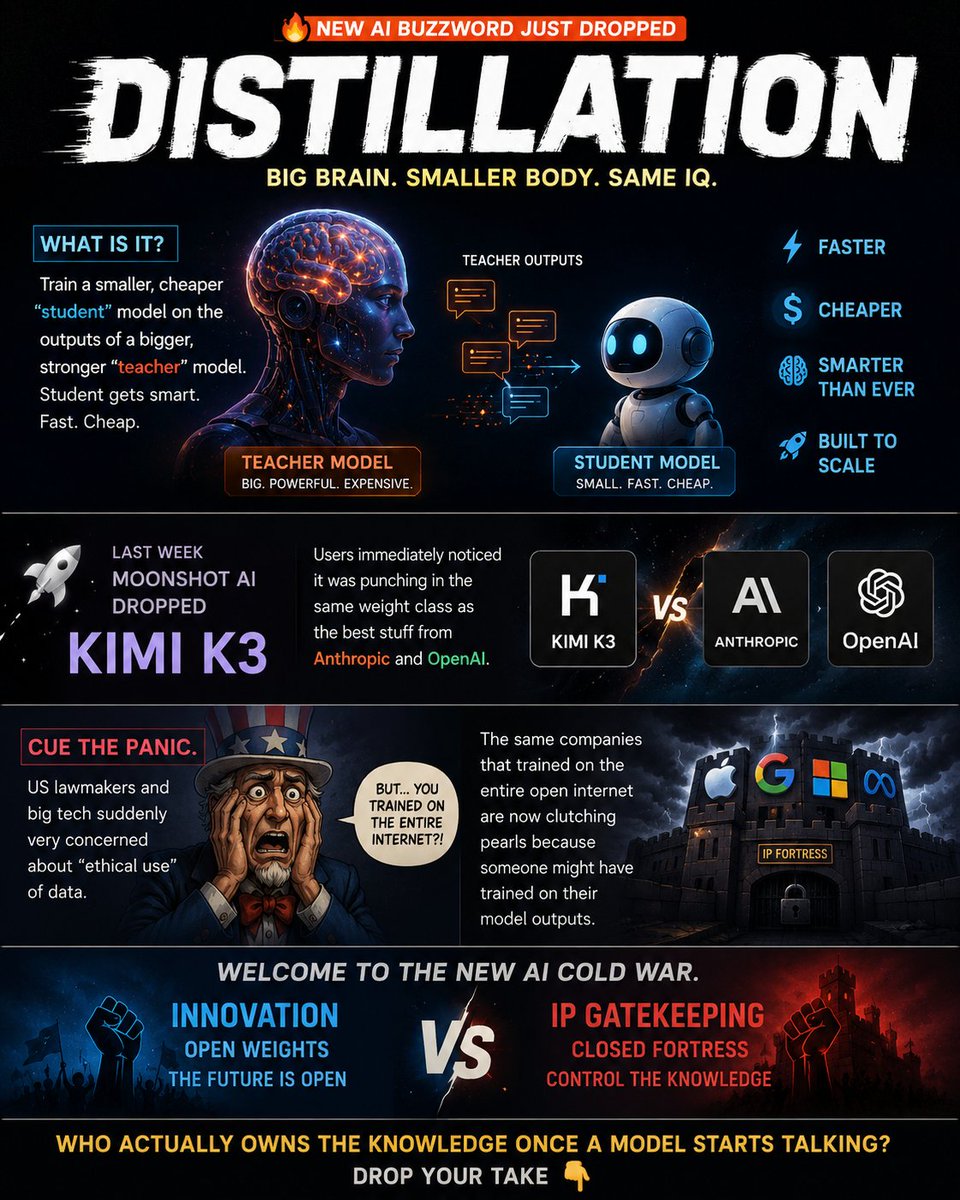 Smart DistillationProprietary AI cartels risk losing their multi-billion-dollar moats because smart distillation allows any agile competitor to siphon the reasoning patterns of a frontier model for the price of a few API calls.
Gifnotes poster
Sources
FAQ
How does a distillation attack actually work?
Instead of stealing the code, you query a giant model millions of times and use its smart answers as the training data for a smaller, cheaper model. The smaller model learns how to think like the big one, minus the expensive development costs.
Why do AI companies care so much about this?
It destroys their moat. They spend hundreds of millions of dollars training a model and adding safety guardrails, only for developers to clone the intelligence and strip the filters using basic API calls.
Does this mean AI safety guardrails are useless?
They work for casual users on the official website, but they do not alter the underlying math. Once the model outputs its data, that data can be used to train a new system that has never heard of a safety filter.