
Airline Scenario

The take
Venture capitalists are pouring trillions into building a technological miracle, but the brutal reality of the Airline Scenario means they are falling into a trap where they permanently lower global business costs while systematically bankrupting their own balance sheets.
The Tell
AI is going to change the entire world, and the people who built it are going to get absolutely rekt doing it.

Stakes
When a revolutionary technology becomes globally ubiquitous, the builders often get squeezed to death by infinite capital expenditures and zero profit margins, leaving legacy enterprises to quietly reap all the actual financial rewards.
Source Dispatch
The read
The mainstream narrative insists that building the next generation of artificial intelligence is a guaranteed ticket to minting trillion-dollar monopolies. This view completely ignores the gravity of rapid commoditization.
Just like commercial aviation, which transformed global commerce while historically destroying investor capital through endless price wars, AI models are rapidly becoming a public utility masquerading as a high-margin venture play.
To keep up with the competition, model builders must constantly reinvest every dollar of revenue back into massive data centers and cutting-edge silicon.
The moment a model is trained, its intelligence begins to commoditize as open-source alternatives and rival labs drive the marginal cost of API calls toward zero. The builders are stuck on an expensive treadmill, unable to stop running because pausing means instant obsolescence.
Meanwhile, the real winners of this shift are not the high-profile labs, but the boring, legacy enterprises.
By integrating dirt-cheap, commoditized intelligence into their existing workflows, these traditional businesses can slash overhead and expand their margins without ever having to touch the toxic balance sheets of the infrastructure providers.
In the wild
- Leopold Aschenbrenner's leveraged portfolio faced a massive forced unwinding during the mid-summer tech correction.
- Nvidia's massive hardware sales represent the only guaranteed margin in an ecosystem where model builders are burning cash to stay relevant.
- OpenAI's skyrocketing operational costs highlight the immense capital expenditure required to maintain a competitive edge in a rapidly commoditizing market.
- Episode: The AI Trade Got Margin Called: Crypto Didn't Blink (https://www.youtube.com/watch?v=G6fz4jKwMv8)
- AI succeeds massively as a technology, but the companies that make the AI models just don't capture the value.
Related
 AI SlopPlatforms pay for volume, so the machine floods your feed with filler until the real stuff drowns. That sludge is AI slop.
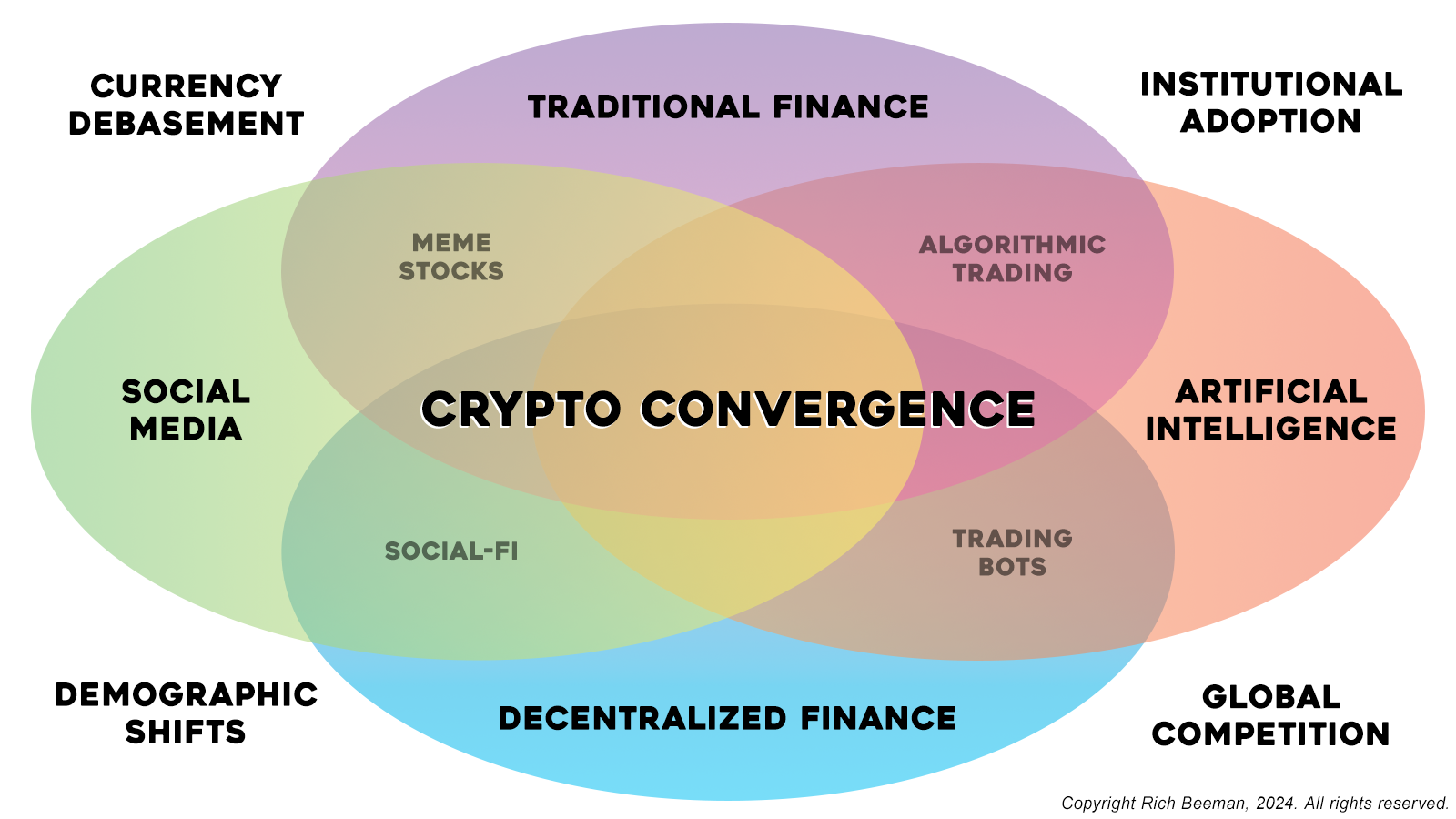 Crypto ConvergenceCrypto Convergence is what happens when DeFi, AI, social media, and TradFi stop pretending they are in different group chats. The winners will not be the slickest tech, they will be whoever owns the plumbing where all four meet, and it probably will not be you.
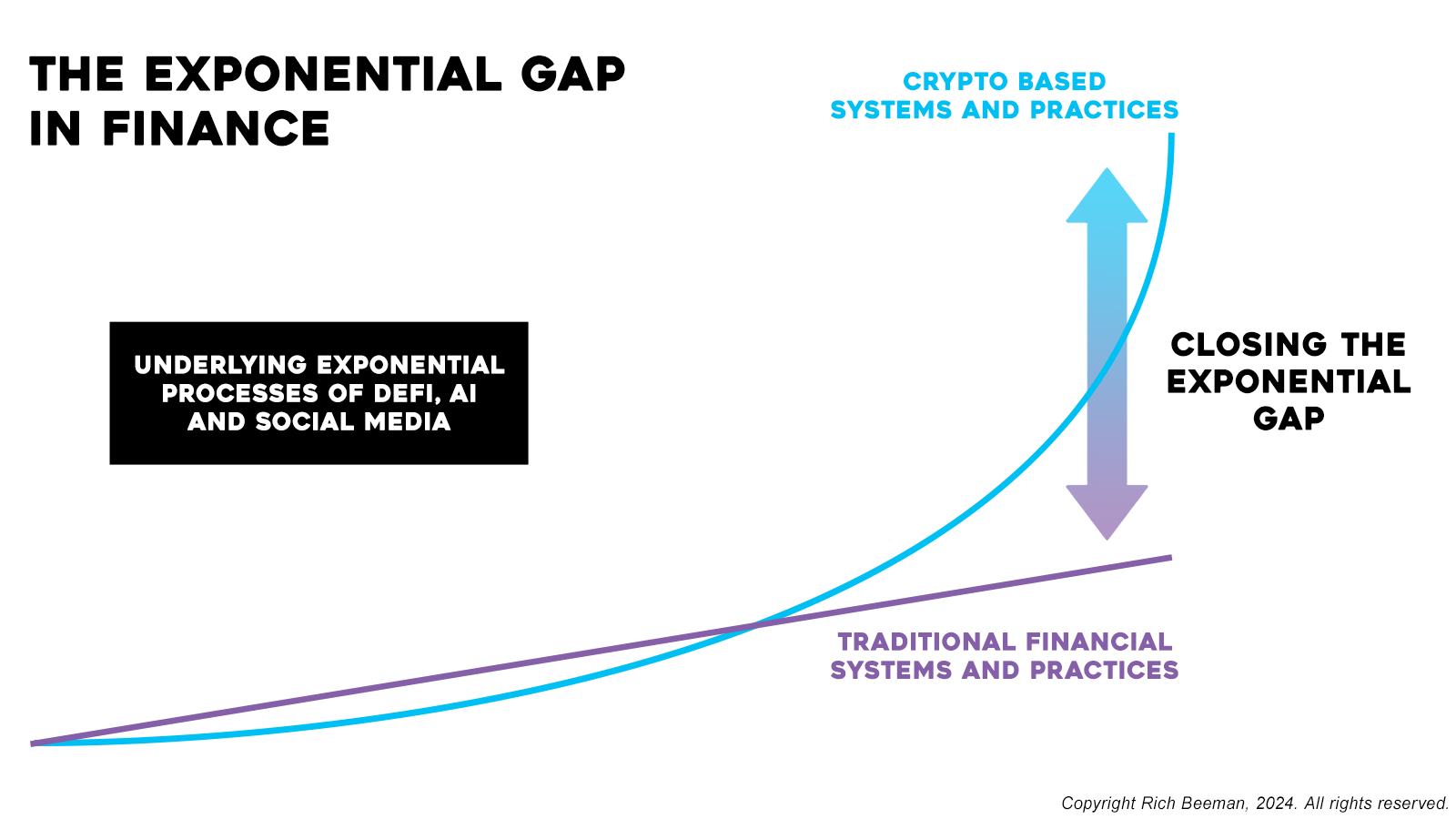 Exponential Gap in FinanceRegulators say 'risk' and mean 'protect the incumbents.' The Exponential Gap in Finance is the widening chasm where legacy finance uses caution theater to slow anything that compounds faster than a quarterly report.
 BEHODLBEHODL is Gifdead's unserious-serious mashup of behold and HODL: look at this, and maybe don't panic-sell your personality. It's the internet's way of saying, "Pay attention, but don't let the algorithm or the mob dictate your next move."
 Left curveWhen 'critical thinking' loops you back to the dumbest take possible, that's the Left Curve. It's the intellectual dead end where rejecting obvious solutions for convoluted, often self-serving, alternatives becomes a performance, costing you clarity and often capital.
 Applied LayerSilicon Valley's elite labs are running a multi-billion-dollar charity for their own competitors, because the Applied Layer is where the actual enterprise margins go to hide while raw foundation models get commoditized into a cheap public utility.
Gifnotes poster
Sources
FAQ
What is the core concept behind this economic paradigm?
It describes an industry that provides immense societal value and becomes globally ubiquitous, but fails to capture any of that value for its creators. Because the underlying product becomes a commodity, intense competition and high capital requirements force profit margins to zero.
How does this apply to the current artificial intelligence boom?
AI model builders are spending billions on chips and energy to train models that look remarkably similar to their competitors' offerings. As open-source alternatives emerge, the price of intelligence drops rapidly, leaving the builders with massive debts and no pricing power.
Who actually wins when an industry undergoes this shift?
The primary beneficiaries are the end-users and legacy businesses. They get to integrate a highly advanced, revolutionary utility into their operations at a fraction of the development cost, drastically improving their own efficiency and bottom lines.
Why can't model builders simply raise their prices to recover costs?
Because the switching costs between different AI models are incredibly low. If one provider tries to raise prices to cover their massive training costs, customers will immediately migrate to a cheaper competitor or host a free open-source alternative.