
Exponential Gap in Finance

The take
Regulators say 'risk' and mean 'protect the incumbents.' The Exponential Gap in Finance is the widening chasm where legacy finance uses caution theater to slow anything that compounds faster than a quarterly report.
The Tell
Exponential Gap: Regulators call it 'unseen risk.' We call it a shield for old money trying to slow down new money. Who benefits from the 'caution'?

Stakes
This gap matters because what's framed as 'consumer protection' often functions as a regulatory moat, slowing down genuinely disruptive financial tech to safeguard the market share of traditional institutions. It limits access to new opportunities and concentrates power, making it harder for everyday investors to participate in the next wave of wealth creation.
The read
Mainstream finance and regulators often frame the exponential gap as a necessary concern, warning of 'unseen risks' in decentralized finance and the need for careful oversight.
They argue that rapid, unregulated innovation could destabilize markets and harm consumers, necessitating a measured approach to protect the public from unknown variables.
However, this narrative subtly launders the fact that much of this 'caution' serves to slow down or stifle innovations that threaten established, linear-growth business models.
When central banks and traditional giants like JPMorgan lobby for stringent regulations on DeFi, citing 'systemic risk,' they're simultaneously developing their own blockchain solutions, effectively building a regulatory moat.
The real 'risk' often lies with their market share, not just public safety. For the sharp reader, understanding this dynamic means recognizing that 'regulatory prudence' can often be a euphemism for protecting existing power structures.
It’s a reminder to look past the headlines and ask who truly benefits when exponential growth is framed as an 'unseen danger'.
In the wild
- Central Banks Grapple with Digital Currency Adoption Pace
- Traditional Banks See Exodus of Young Investors to Crypto Platforms
- AI-Driven Hedge Funds Outperform Market Benchmarks
- Regulators Warn of 'Unseen Risks' in Decentralized Finance
Related
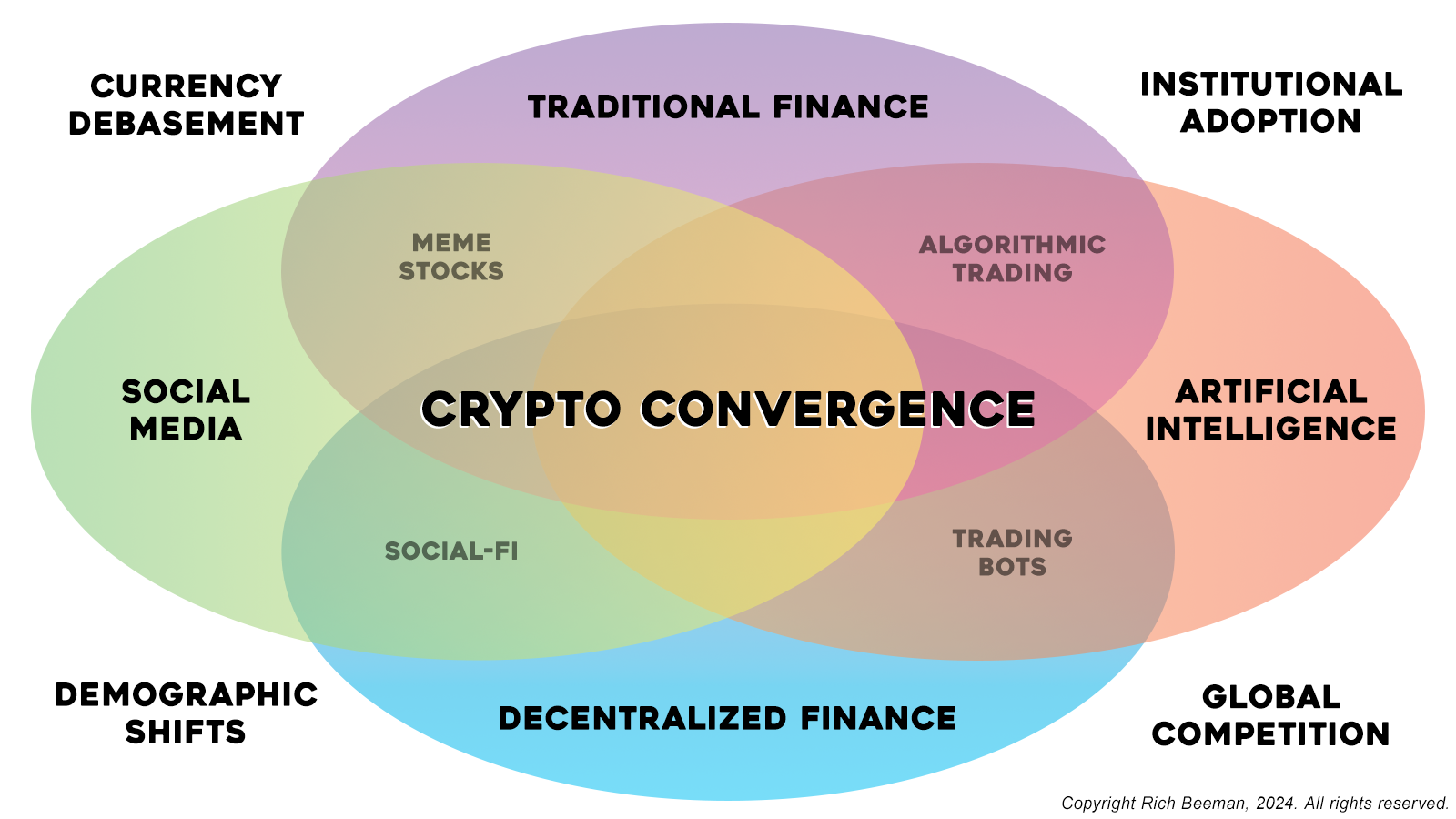 Crypto ConvergenceCrypto Convergence is what happens when DeFi, AI, social media, and TradFi stop pretending they are in different group chats. The winners will not be the slickest tech, they will be whoever owns the plumbing where all four meet, and it probably will not be you.
 Lightning IndexerIngenuity now beats brute force in the AI arms race, and the Lightning Indexer is the architectural tell that proves it, making advanced AI accessible to agile teams because the future of AI isn't just about who has the biggest supercomputer.
 AI 2027 ScenarioThe 'AI 2027 Scenario' is less a sober forecast of superintelligence and more a high-stakes marketing push, designed to accelerate the AI arms race and consolidate power, because the only thing scarier than AI is the other guy getting it first.
 Technical Leadership DrainWhen MBAs and financial managers replace engineers at the top, companies often trade their innovation edge for short-term gains, a Technical Leadership Drain that costs them long-term market dominance.
 Barbell Strategy (Digital)The digital Barbell Strategy is the market's blunt memo: the middle is dead. Cling to mediocre middle offerings and you pay with irrelevance.
 Economic Immune System ResponseWhen financial systems fight back against reformers, it's not due process. The 'economic immune system response' is the reflexive, often aggressive, self-preservation mechanism of entrenched systems, and understanding this trap is crucial for anyone trying to fix systemic fraud.
Gifnotes poster
Sources
FAQ
How does the Exponential Gap affect innovation in finance?
It creates a bottleneck, favoring established players and slowing the adoption of truly decentralized, exponential-growth technologies, even as those same institutions explore similar tech internally.
Who benefits most from the current 'cautionary' approach to new financial tech?
Primarily incumbent traditional financial institutions and central banks, who gain time to adapt, develop their own versions, and solidify their market position while competitors face higher regulatory hurdles.
What should an informed investor consider given this gap?
Look beyond official warnings to understand the underlying incentives. Evaluate new financial technologies based on their fundamentals and potential, rather than solely on regulatory rhetoric, and consider the long-term implications of centralized control versus decentralized innovation.